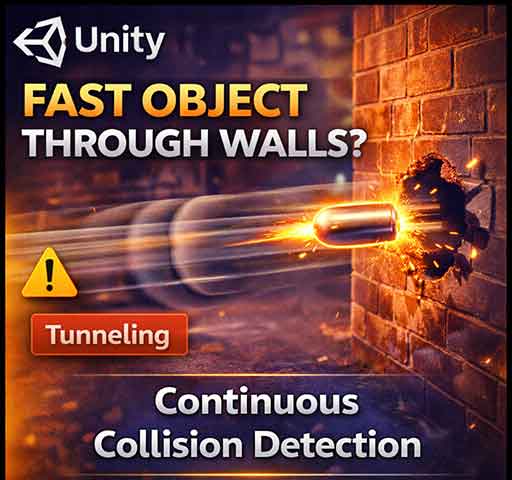
Have you ever shot a bullet, thrown a fast ball, or moved a car quickly in Unity, only to see it pass right through a wall or floor? This frustrating behavior is called tunneling.
It’s a common problem for fast-moving Rigidbody objects. Understanding why it happens and how to fix it is critical for any physics-heavy game.
Why Tunneling Happens
Unity physics runs in fixed steps. By default, FixedUpdate runs every 0.02 seconds (50 Hz). During each step, Unity calculates collisions between positions.
If an object moves too far in a single physics step, it may skip over a collider entirely. The physics engine never detects the collision → the object “tunnels” through.
Think of it as taking big leaps over small obstacles instead of touching them.
Key Factors That Cause Tunneling
High speed of the Rigidbody
Small collider thickness on walls or obstacles
Low fixed timestep
Discrete collision detection (default)
Solution 1: Enable Continuous Collision Detection
Rigidbody has a Collision Detection setting. By default, it is set to Discrete, which is fast but can miss collisions.
Change it to:
Continuous: For moving objects that collide with static geometry
Continuous Dynamic: For moving objects colliding with other moving objects
This guarantees detection even for extreme speeds.
Best Practices Summary
Use Continuous collision detection for fast-moving Rigidbodies
Reduce Fixed Timestep if needed
Keep colliders reasonably thick
Clamp object speed
Consider raycasting for small fast projectiles
Performance Considerations
Continuous collision detection is more expensive than discrete
Lowering Fixed Timestep increases physics calculations per second
Only enable for objects that need it
Final Thoughts
Tunneling is not a bug—it is a consequence of discrete physics simulation. Understanding how Unity performs collision detection allows you to prevent objects from passing through walls while keeping your game performant.
By combining Continuous collision detection, careful timestep settings, proper collider sizing, and raycasting when needed, you can handle fast-moving objects reliably and avoid tunneling in your games.